Writing in the Dark: What Happens to Prose When No One Is Watching
The Imagined Reader Who Never Leaves
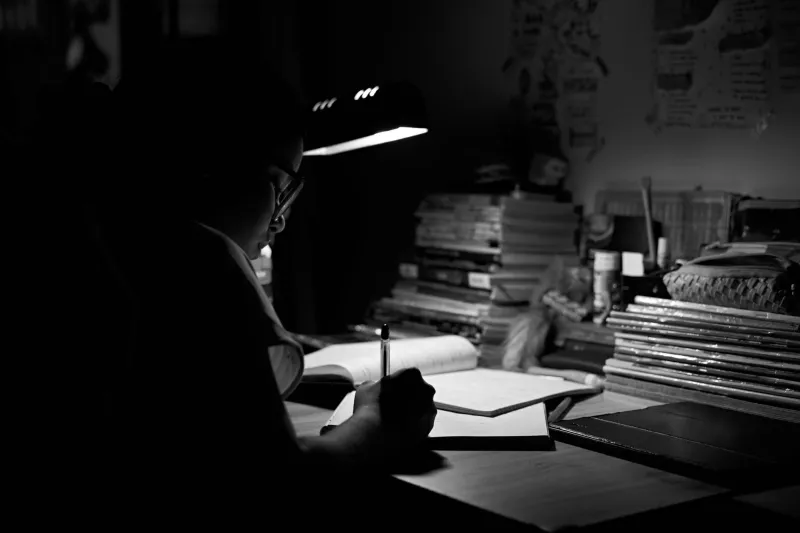
Every act of writing is, in some measure, a social act. Even the most solitary writer — hunched over a legal pad at two in the morning, curtains drawn, phone silenced — is composing for someone. The reader may be hypothetical, idealized, or entirely unconscious, but they are present. They sit just beyond the margin of the page, exerting a gravitational pull on word choice, sentence rhythm, and the degree to which a writer is willing to expose what they actually think.
This is not a flaw in the writing process. It is, arguably, its engine. But it raises a question worth sitting with: what changes when that imagined reader is finally, genuinely removed? What prose emerges in the space where no audience — real or constructed — can follow?
The answer, for most writers who have kept journals or drafted work they never intended to share, is both liberating and slightly alarming.
The Private Register
There is a version of every writer that exists only in their notebooks. It speaks differently than the published self. The sentences are looser, the confessions more direct, the self-pity less disguised. Observations that would be softened for public consumption arrive without apology. Contradictions are permitted to stand unresolved. The private register, as one might call it, does not perform.
What is striking about this register is how often it contains a writer's clearest thinking. The very absence of an audience seems to dissolve certain defensive habits — the tendency to qualify, to charm, to anticipate objection. When a writer believes no one is reading, they frequently stop trying to be interesting and simply become honest.
This raises an uncomfortable implication for anyone who publishes: that the most authentic version of the work may be the one that never reached the reader.
The Performance Embedded in Publication
To publish is to perform. This is not a cynical observation but a structural one. The moment a writer considers submitting a piece, a manuscript, or even a social media post, a second consciousness enters the room — one that begins editing not merely for clarity but for reception. Certain vulnerabilities get smoothed over. Certain admissions get redirected into safer metaphors. The raw material of genuine experience passes through a filter calibrated to the anticipated audience.
This filter is not without value. Craft, after all, is largely the art of making private experience legible to a stranger. The transformation of raw feeling into shapely prose is precisely what separates a diary entry from a short story. But the process of shaping is also, inevitably, a process of selection — and what gets selected out is often what was most true.
Many writers describe the experience of revising early drafts as a slow negotiation between the self that wrote in darkness and the self that must eventually stand in light. The first draft, written when the writer still believed they were alone, frequently contains the emotional core of the work. Subsequent drafts, written with the reader in mind, build the architecture around it. The question of how much of that original darkness to preserve — and how much to translate into something more presentable — may be the central tension of literary craft.
Vulnerability as Technique
The writers whose work tends to stay with readers longest are often those who found a way to carry the private register into public prose. They write with the directness of someone who forgot, or chose to ignore, that they would eventually be read. The sentences feel unguarded in a way that is difficult to manufacture and impossible to fake.
This quality — call it literary vulnerability — is not the same as confession. A writer can be ruthlessly honest about ideas, observations, and the textures of consciousness without disclosing biographical detail. What distinguishes vulnerable prose is not its subject matter but its relationship to the reader: it does not flinch, does not retreat behind irony, does not position itself at a safe aesthetic distance from what it is actually trying to say.
Achieving this in published work requires a particular kind of courage — the willingness to write as though no one is watching, while knowing full well that everyone eventually will be.
The Discipline of Forgetting the Audience
Some writers develop deliberate practices to recover the private register in their public work. They draft in longhand, which slows the internal editor. They write at unusual hours when the critical faculty is less alert. They begin with the explicit instruction to themselves that the draft will be destroyed — a fiction that sometimes lasts long enough to produce something worth keeping.
Others work in the opposite direction: they write with a specific reader in mind, someone so particular and so trusted that the usual performance anxiety dissolves. The imagined reader becomes, paradoxically, a way of removing the imagined reader — replacing the faceless crowd with a single face that requires no performance.
Both approaches are attempts to solve the same problem: how to write with the freedom of solitude while producing work capable of reaching another mind.
What the Private Page Reveals
The most honest writing most of us will ever produce sits in notebooks no one will read, in deleted drafts, in letters we composed and chose not to send. There is something worth acknowledging in that fact — not with regret, but with curiosity.
The gap between the writer we are in private and the writer we become in public is not a failure of nerve. It is the record of a negotiation that every author undertakes, consciously or not, every time they sit down to work. Understanding that gap — tracing its contours, learning where it narrows and where it widens — may be one of the more honest forms of self-knowledge available to anyone who writes.
The prose that stays with readers is rarely the prose that played it safe. It is, more often, the prose that carried some remnant of the dark — some trace of the sentence written when the writer still believed, however briefly, that no one was watching.