Ghosts Between the Pages: What Forgotten Bookmarks Reveal About the Reader You Used to Be
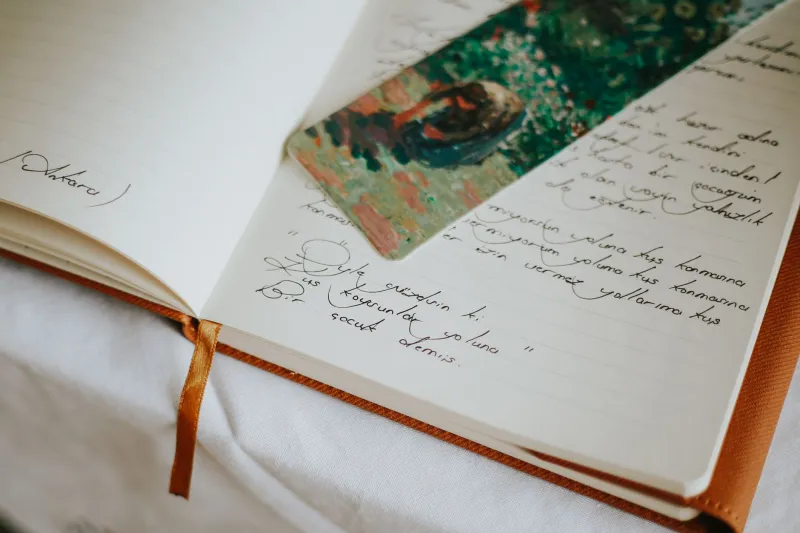
There is a particular kind of vertigo that arrives not from a great height, but from a small, unremarkable scrap of paper. A grocery receipt from a store that closed a decade ago. A pressed maple leaf gone brittle at its edges. A handwritten phone number belonging to someone whose face you can no longer quite assemble in your mind. These objects surface when we return to books we once loved, and they carry a charge that no literary device quite replicates. They are evidence. They are proof that someone—someone who shares your name and your handwriting but perhaps very little else—sat down with this same novel under circumstances you have since forgotten.
The bookmark, in its many accidental forms, functions as a kind of time machine. Not the dramatic, cinematic variety, but something far more unsettling: the sort that deposits you in front of your former self without warning and without the courtesy of preparation.
The Archaeology of the Interrupted Read
Most readers do not think of themselves as archivists. We reach for whatever is at hand—a boarding pass, a birthday card envelope, a torn strip of paper bag—and we slide it between the pages with the casual confidence of someone who believes they will return to this book within the week. We rarely do. Life intervenes, as it reliably does, and the book migrates to a shelf, a moving box, a storage unit, and eventually back into our hands years later.
What we find inside is not merely a placeholder. It is a stratigraphic record. Archaeologists speak of reading the earth in layers, each stratum telling the story of a different era. Our books accumulate their own strata—not in soil but in paper, in ink, in the dried residue of a coffee ring on the back cover. The forgotten bookmark is the most concentrated of these deposits. It was placed with intention, however minor, and it waited.
Consider what it means to open a copy of a novel you first read in your twenties and discover a pay stub from a job you held briefly and badly. The numbers printed there—the hours, the gross pay, the deductions—constitute a kind of autobiography you never consciously wrote. You remember, suddenly, the apartment you lived in when you read those early chapters. You remember what you were afraid of then, and whether those fears proved justified.
The Same Book, an Entirely Different Experience
Literary scholars have long observed that a text is not a fixed object. It shifts in meaning as culture shifts, as language evolves, as critical frameworks come in and out of fashion. What receives less attention is the degree to which the reader, rather than the text, is the primary variable. We are not the same people we were at twenty-two, or thirty-five, or forty-eight. Our values have been tested and revised. Our tolerances have expanded in some directions and contracted in others. The things that moved us to tears now may strike us as sentimental; the passages we once skipped impatiently may now seem like the most honest writing in the book.
The forgotten bookmark makes this transformation impossible to ignore. When you find an old note tucked into chapter seven—a note in your own handwriting, marking a passage you apparently found significant—and you read that passage now and feel nothing in particular, the gap between your former self and your present one becomes measurable. It has a location. It has a date, more or less.
Conversely, there is the experience of finding an old marker at a point in the narrative that now seems almost prophetic in its placement. You stopped here, years ago, without knowing why the story would matter to you differently later. The book waited. You caught up.
What We Chose to Save
The nature of the object itself carries meaning. A pressed flower suggests a certain romantic temperament, or a specific occasion—a walk, a gift, a season of life defined by outdoor afternoons. A ticket stub from a concert or a film places the reading within a cultural moment, connecting the private act of reading to the public world that surrounded it. A child's drawing, used as a bookmark by a parent, tells a story about whose needs organized the household during those years.
Perhaps most revealing are the handwritten notes. Not annotations in the margins—those are deliberate, composed with at least some awareness of posterity—but the casual scraps: a to-do list, a phone number, a fragment of an address. These were never meant to be read again. They were never meant to survive. Their survival is an accident, and accidents, as any novelist knows, are often where the truth lives.
The to-do list from a decade ago itemizes what once felt urgent. The phone number belongs to a relationship that has since changed shape entirely. The address leads somewhere you no longer go. Each of these fragments, discovered in the crease of a novel you loved, becomes a kind of found poem about impermanence.
The Book as Witness
There is a reason we speak of certain stories as ones that stay with us. It is not only that the narrative lingers in memory, or that a particular character continues to feel like a genuine acquaintance. It is also that the physical book—the specific copy we held, annotated, and marked—becomes a container for our own history. The text and the life interpenetrate. The story we read and the story we were living at the time of reading become difficult to fully disentangle.
This is not a flaw in the reading experience. It is, arguably, its richest feature. The reader who returns to a formative novel and finds it unchanged has encountered only half the truth. The other half is the evidence of their own passage through time, preserved between the pages with all the fragility and specificity of a pressed leaf: still recognizable, but no longer alive in quite the same way.
The bookmark does not mark where you stopped. It marks where you were. That is a different thing entirely, and it is worth pausing over—worth sitting with, the way one sits with a photograph from a year that feels both recent and impossibly remote.
The book waited for you. The question the forgotten object asks, quietly and without judgment, is whether you were ready to return.