The Library You'll Never Finish: On the Compulsive Pleasure of Owning Books You May Never Read
The Shelf as Self-Portrait
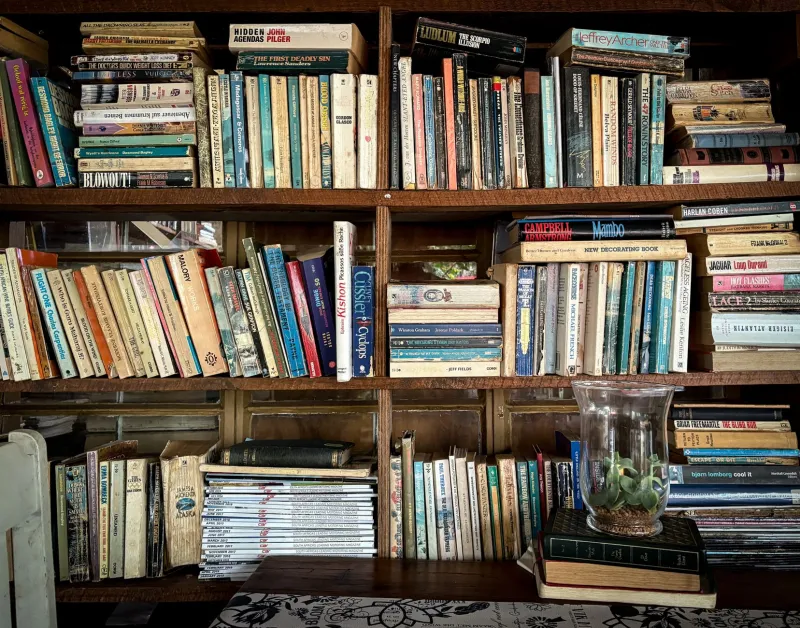
There is a particular kind of shame that visits you in the quiet hours—the kind that arrives when you slide yet another newly purchased novel onto a shelf already crowded with volumes you have not opened in years, or perhaps have never opened at all. You tell yourself this one will be different. You tell yourself you will get to it by spring, by summer, by the time the weather changes. The book settles into its place on the shelf, and the feeling that brought you to the bookstore or sent your cursor toward the checkout button slowly dissipates, replaced by something only slightly less satisfying than actually reading.
This is the condition of the accidental collector—the reader who began, earnestly enough, with a modest stack of intended reads and arrived, without fully noticing the transformation, at something closer to a private archive. It happens to the most disciplined among us. It is, in many respects, the occupational hazard of caring about literature at all.
Acquisition as Anticipation
The Japanese have a word for this phenomenon: tsundoku, the act of acquiring books and allowing them to pile up unread. That such a word exists at all suggests the behavior is neither new nor geographically isolated. But the contemporary American reader faces conditions that earlier generations of book lovers could scarcely have imagined. Algorithmic recommendation engines on platforms like Goodreads and Amazon have become extraordinarily skilled at identifying the precise title most likely to make you feel that you simply must own it immediately. Social media feeds populate with literary enthusiasm from accounts devoted entirely to curating the next essential read. Independent bookstores—blessedly alive and thriving in many American cities—arrange their tables with the practiced intention of a jeweler displaying gems.
The result is a purchasing environment engineered, at virtually every touchpoint, to accelerate acquisition far beyond any individual's reading capacity. The average American reads, according to Gallup surveys, somewhere between four and twelve books per year. The average enthusiastic reader likely purchases considerably more than that. The math is not forgiving, and most of us stopped doing it long ago.
Yet the compulsion persists, and it would be too easy—and too inaccurate—to attribute it solely to commercial manipulation. Something genuine and deeply human drives us toward these unread spines. The act of purchasing a book is itself an act of intention, a small, affordable declaration that we are the kind of person who would read this, who cares about the subject or the author or the world the novel promises to open. The book becomes a physical token of an aspiration.
The Dopamine of Ownership
Researchers studying consumer behavior have long understood that the anticipation of a pleasurable experience frequently delivers a neurological reward comparable to the experience itself. The bookstore browser who discovers an author she has been meaning to explore receives a genuine hit of satisfaction at the moment of purchase—one that is not contingent on the reading ever taking place. The book, once owned, has already partially fulfilled its psychological function.
This is not self-deception in any straightforward sense. It is closer to the way a well-equipped kitchen makes a person feel more capable of cooking ambitious meals, regardless of whether those meals are ever attempted. The library communicates something to its owner before a single page is turned. It says: these are the territories I intend to inhabit. These are the conversations I mean to join.
The guilt, of course, follows. Anyone who has moved apartments and been confronted with the sheer physical weight of boxes filled with unread books understands the particular variety of self-recrimination that accompanies the realization. Each unread spine is a small, silent accusation—not merely of idleness, but of a kind of dishonesty about who we actually are versus who we have been performing ourselves to be.
The Library as Autobiography
And yet, I would argue, that accusation deserves to be contested. The books we accumulate without reading are not evidence of failure. They are evidence of a rich and restless intellectual appetite—one that cannot always be satisfied at the pace the world demands. The unread library is, in its way, an autobiography of curiosity: every volume a record of a moment when something caught your attention, stirred your interest, made you feel that the world was larger and more worth exploring than you had remembered.
The philosopher Umberto Eco, who maintained a personal library of some thirty thousand volumes, reportedly grew impatient with visitors who asked how many of those books he had read. The library's value, in his view, lay precisely in what remained unread—in the daily reminder that knowledge exceeds any single life's capacity to contain it. The unread book is not a reproach. It is a horizon.
This reframing matters, particularly in a cultural moment that tends to measure the value of reading in terms of volume and velocity—the number of titles completed, the annual reading challenge met or missed. Treating literature as a consumption metric reduces it to something it was never meant to be. The books we own and have not yet read are not failures of productivity. They are invitations that remain open.
When the Pile Becomes a Problem
None of this is to suggest that the accidental collector's habits are beyond examination. There is a meaningful difference between a library that reflects genuine aspiration and one that has become a form of retail therapy—a substitute for the intellectual engagement it was meant to enable. When the pleasure of acquisition entirely displaces the pleasure of reading, something has been lost.
The more useful question to put to your own shelves is not how many books you have failed to read, but whether the library you have assembled still speaks to you—whether those unread spines represent desires that remain alive or ones that have quietly expired. Culling a personal library is, in this sense, an act of honesty: an acknowledgment that the person who bought that particular book five years ago and the person standing in front of the shelf today are not precisely the same individual.
The Story the Shelf Tells
What endures, and what I find most worth preserving in the accidental collector's relationship to books, is the fundamental generosity of the impulse. To acquire a book is to believe, however briefly and however optimistically, that you will find the time and the attention and the appetite to enter someone else's world completely. That belief, even when it outpaces reality by a considerable margin, is not something to be embarrassed about.
The library you will never entirely finish is, in the end, the most honest kind. It tells the truth about who you are: someone for whom the world of books is inexhaustible, whose curiosity refuses to be fully satisfied, who keeps reaching toward the next horizon even knowing the previous ones have not all been crossed. That is not hoarding. That is, in its way, one of the more admirable things a reader can be.