When the Margin Note Becomes a Mirror: How Annotated Passages Reveal the Reader You No Longer Are
The Annotation as Artifact
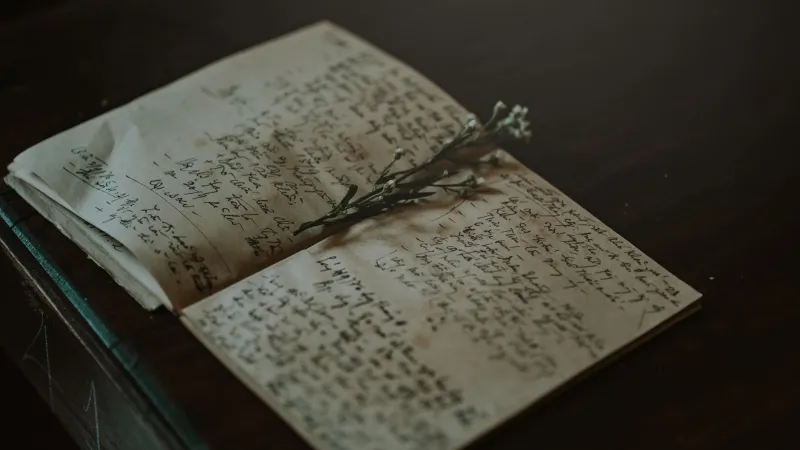
Open an old paperback—one you carried through a particular season of your life—and you will likely encounter evidence of a reader who no longer exists. A phrase underlined in pencil. An asterisk beside a paragraph that, on this second reading, seems perfectly ordinary. A single word written in the margin: yes, or this, or sometimes just an exclamation mark, urgent and orphaned, stripped of the context that once made it feel necessary.
These markings function as a kind of unintentional autobiography. Unlike a journal entry, which is composed with at least some awareness of a future reader, an annotation is almost always made in the grip of the present tense—a reader reaching for a pen because something in the prose has struck them with enough force to demand acknowledgment. There is no performance in it. The mark is genuine. And that is precisely what makes returning to it so unsettling.
The passage you underlined at twenty-three may have spoken directly to a heartbreak you were navigating, a professional failure you were rationalizing, or a philosophical question you had only just begun to take seriously. Return to it at forty, and the words may seem inert—competent, perhaps, but no longer charged with anything resembling personal necessity. The book has not changed. You have. And the annotation, frozen in ink, refuses to pretend otherwise.
The Phenomenon of the Inverted Meaning
Among the more unsettling variations of this experience is the discovery that a passage you once found affirming now reads as a warning. A line about solitude that once felt like permission may, years later, read as a description of avoidance. A character's defiance that once seemed heroic may, with the benefit of hindsight, look like a portrait of self-destruction.
This inversion is not a failure of the original reading. It is, in fact, evidence that literature is doing exactly what the best of it is designed to do: remaining open to interpretation across the full arc of a life. The novelist did not write one fixed meaning into the sentence. The reader brought a meaning to it, and that meaning was true—true to who the reader was at that precise moment. The fact that it no longer holds does not invalidate it. It complicates it, which is something altogether different.
What makes this phenomenon particularly interesting from a craft perspective is that it exposes the degree to which reading is collaborative. We speak often about what an author intended, but the annotated page makes visible what the reader contributed—the private associations, the emotional urgency, the life circumstances that caused one sentence to vibrate while the paragraph beside it passed without notice. The highlighted passage is never just about the text. It is about the intersection of the text and a specific human life at a specific moment in time.
Why Some Readers Find This Unsettling
For certain readers, encountering these stranded markings produces something close to grief. There is a loss implicit in the recognition that a passage which once felt essential now feels merely adequate. It can seem, however irrationally, as though something has been taken—some capacity for wonder, or some tenderness of feeling, that the younger reader possessed and the current one does not.
This response is understandable, but it may rest on a misreading of what has actually occurred. The passage did not diminish. The reader grew past the specific need that made it luminous. That is not deterioration; it is motion. The unsettling quality of the stranded annotation is, in this sense, the unsettling quality of evidence that time has passed and that one has been changed by it—which is to say, it is the unsettling quality of being alive.
There is also a particular vulnerability in these markings that can feel exposing. The annotation does not allow for revisionism. You cannot claim, in retrospect, that the passage was always a minor one, or that you always read it with detachment. The ink says otherwise. The person who made that mark cared, and the current reader must reckon with that care even when it no longer feels familiar.
The Case for Celebrating the Distance
Other readers approach these same discoveries with something closer to satisfaction. To look at a margin note from a decade ago and recognize a sensibility you have since outgrown is to hold proof of development in your hands. The annotation becomes not a record of loss but a measure of distance traveled.
This is, in many ways, the more generous interpretation—and arguably the more accurate one. A reader whose relationship to a given passage has not shifted over the course of fifteen years might reasonably ask whether they have been doing the work that serious reading demands: the work of bringing new experience to old texts, of allowing a richer life to complicate earlier certainties, of remaining genuinely open to reinterpretation rather than simply confirming what one already believes.
The readers who celebrate the evolution tend to approach their annotated books less as sacred objects and more as correspondence—letters exchanged between successive versions of themselves, with the text serving as the shared occasion for the exchange. In this view, the margin note is not embarrassing. It is honest. It is the record of an authentic encounter, and the fact that a later encounter differs from it is not a contradiction but a continuation.
What the Marked-Up Book Teaches Us About Reading
The broader lesson embedded in this experience may be one of the most important that serious reading has to offer: meaning is not a fixed property of a text. It is something that arises between the text and the reader, and because the reader is always changing, the meaning is always, in some degree, in motion.
This does not make reading arbitrary. It does not suggest that all interpretations are equally valid or that the author's choices are irrelevant. It suggests, rather, that the life a reader brings to a book is itself a kind of intelligence—one that shapes what can be seen in the prose, what can be felt in the rhythm of a sentence, what can be recognized in a character's predicament.
To return to an annotated book is to conduct a kind of audit of that intelligence across time. The passages you marked are a record of what you were capable of noticing, and what you needed to find, at a particular moment in your reading life. The passages you would mark today—different ones, perhaps, or the same ones for entirely different reasons—are a record of where you stand now.
Between those two sets of marks lies the story of a reader. And that story, it turns out, is one worth paying attention to.