Ghosts Between the Pages: What Forgotten Bookmarks Tell Us About Who We Used to Be
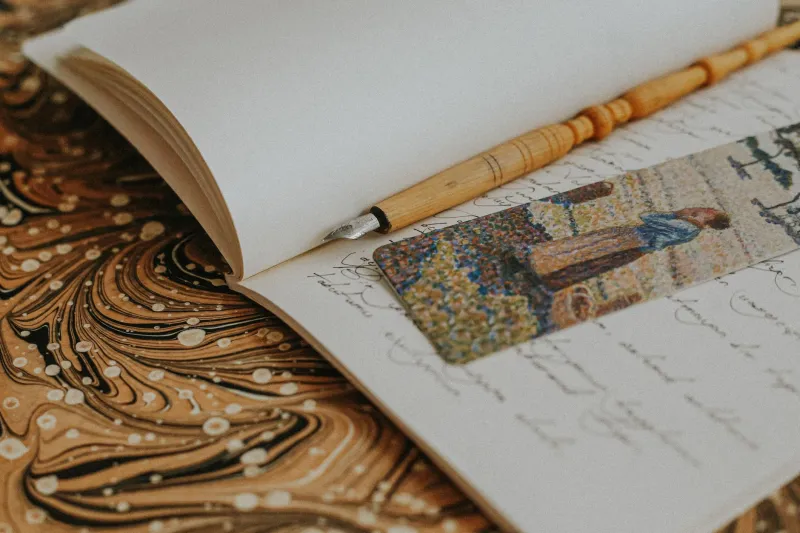
A boarding pass from a flight you barely remember. A coffee shop receipt dated years before your life looked anything like it does now. A handwritten note in your own script, in handwriting that no longer quite resembles yours. The objects we leave inside books are not accidents—they are the quiet autobiography of a self we have half-forgotten.
There is a particular kind of vertigo that arrives when you pull an old novel from the shelf and something falls out. Whatever the object may be—a drugstore loyalty card, a dried flower, a strip of paper torn from a grocery list—it carries with it the compressed weight of a specific moment. You were somewhere. You were someone. And you were reading.
The Accidental Archive
Most of us do not set out to document our inner lives with any great deliberateness. We do not think, on a Tuesday evening in October, that the gas station receipt we have just slipped between pages 214 and 215 of a novel will one day serve as evidence of who we were at thirty-two. And yet that is precisely what it becomes.
Reading, it turns out, is one of the most self-revealing activities a person can undertake—not merely in the books we select, but in the physical record we leave behind within them. Literary scholars speak of marginalia, those notes scrawled in the borders of texts, as historical artifacts that illuminate how readers of previous centuries engaged with ideas. But the same logic applies, in a far more personal register, to the ordinary detritus we deposit inside our own books without a second thought.
Consider what a researcher might conclude if they were handed a box of your books from a decade ago. The receipts would reveal where you spent your time and how much money you had. The business cards would suggest who you were meeting. A birthday card tucked into a novel might indicate that someone thought of you as a reader. The pages at which you stopped—particularly if you never returned—might point toward what was happening in your life that made continuation impossible.
This is not merely speculation. It is the accidental autobiography that every committed reader compiles across a lifetime.
When We Stopped and Why
Perhaps the most telling artifact of all is not what we leave inside a book, but where. The placement of a bookmark is a frozen moment of intention—a declaration, however casual, that you meant to return. Sometimes you did. Often you did not.
The books we abandoned are among the most honest records we possess. A novel left unfinished at page sixty might speak to a period of crisis, when concentration became a luxury rather than a given. A self-help title stopped at the first chapter might indicate that the crisis passed, or that the advice proved inadequate, or simply that something else arrived to demand your attention. A collection of poetry with a bookmark near the end—but not quite at it—might suggest that you were savoring the approach, unwilling to let it conclude.
None of these interpretations is definitive. That is part of what makes the exercise so absorbing. The books themselves cannot tell you the whole story. They can only offer the outline, and you must supply what remains.
Reading in Seasons
There is a rhythm to the books that find us at different points in our lives, and it is rarely accidental. The novels we consumed in our twenties, often breathlessly and in great quantities, tend to reflect a hunger for experience we had not yet accumulated. The history and biography that absorbs us in middle age frequently mirrors an attempt to locate ourselves within a longer continuum—to understand, through the lives of others, something about the arc of a life. The quieter, more contemplative reading that often arrives later may suggest a desire for depth over breadth, for the sentence that rewards slow attention rather than the plot that compels speed.
These are generalizations, of course, and every reader will recognize the exceptions in their own history. But the broad pattern holds: our reading is not static. It shifts as we do, and the books on our shelves—particularly those we have kept across multiple moves and life transitions—form a kind of stratigraphy, a geological record of who we have been.
When you discover a bookmark in a book you last opened during your first year living alone in a new city, you are not simply recalling a story. You are recovering a self. The reading you did then was shaped by the particular quality of that solitude, by the specific questions that city asked of you, by the version of ambition or grief or hope you were carrying at the time.
What We Kept and What It Means
Not every book survives every move. Most readers, at some point, have stood before a shelf with a box at their feet, making decisions that feel more consequential than they should. What we choose to keep is, in its own way, a form of self-definition.
The books that remain are the ones that have, in some sense, earned permanence in our lives. They may not be the best books we have read. They may not even be books we would recommend without hesitation. But they carry something—an association, a residue of feeling, a memory of the particular afternoon or year in which they mattered—that makes their removal feel like a small erasure.
And within those survivors, the bookmarks and inscriptions and folded corners accumulate. A library built over decades becomes something more than a collection of texts. It becomes a record of encounters, a physical map of the mind at various stages of its formation.
The Reader You Were, the Reader You Are
There is a quiet discipline in returning to books from earlier chapters of your life—not necessarily to reread them in full, but simply to hold them and remember. To find the receipt, the ticket stub, the note. To ask what that object was doing there, and what you were doing then.
The stories that stay with us are not only the narratives printed on the pages. They are also the stories of how we read them: where we were, what we were hoping for, what we were trying to survive or understand or celebrate. The bookmark is not merely a placeholder. It is a witness.
And if you are fortunate—if you have kept enough books across enough years—you will one day open a volume and find something that stops you entirely. Something that returns you, with unexpected precision, to a moment you thought you had lost. The story printed on those pages may be someone else's invention. But the story held between them is entirely your own.