The Books We Go Back To: On the Strange Comfort of Rereading Old Favorites
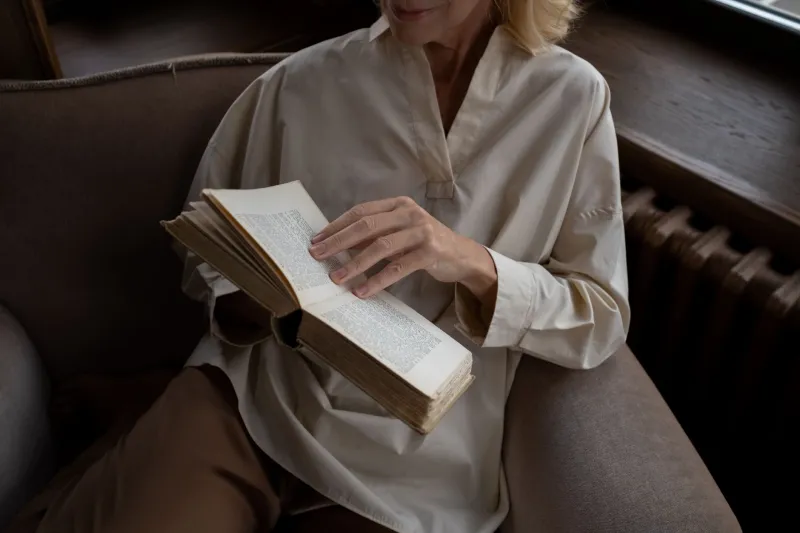
Somewhere in America right now, a person is reading Little Women for the seventh time. Another is working through The Catcher in the Rye again, not because they assigned it to a class or need a refresher for some literary argument, but because something in the past week—a bad phone call, a particular quality of October light, a feeling they cannot yet name—sent them back to the shelf to pull it down. They know how it ends. They know it almost too well. They are reading it anyway.
This is not an unusual behavior, though in an era of algorithmic recommendation engines and an unceasing flood of new titles, it can feel faintly transgressive. The literary culture around us is oriented almost entirely toward the new: the debut novel generating advance buzz, the prize shortlist, the book everyone will be discussing at dinner parties by February. Against this current, the rereader swims quietly in the other direction, choosing the familiar over the undiscovered, the known over the possible. And in doing so, they are practicing something that deserves more serious examination than it typically receives.
Why We Go Back
The psychology of rereading is, at its core, the psychology of comfort—but that word does insufficient justice to the phenomenon. Comfort implies passivity, a kind of retreat from engagement. What rereading actually offers is something more active: a controlled re-encounter with a text that has already proven itself capable of moving you, during a moment when you need to be moved.
Psychologists who study what is sometimes called "narrative transportation"—the degree to which a reader becomes absorbed into a story's world—have noted that rereading a beloved book often produces a deeper experience of immersion than the first reading did. On the initial pass, a portion of the reader's cognitive attention is necessarily devoted to tracking plot, learning characters, and building the architecture of the fictional world. On subsequent readings, that scaffolding already exists. The reader can move through the text more slowly, attend to sentences they previously rushed past, and notice thematic patterns that were invisible when the ending was still unknown.
What this means, practically, is that a book you have read three times is in some meaningful sense a different book each time—not because the words have changed, but because you have. The text is a fixed object; the reader is not.
The Books That Become Landmarks
Ask devoted rereaders which titles they return to most consistently and a handful of patterns emerge. There are the books encountered in adolescence that served as maps during a period of profound disorientation—the novel that made a lonely fourteen-year-old feel, for the first time, genuinely understood. There are the books absorbed during a formative relationship, now inseparable from the memory of the person who recommended them. And there are the books that accompanied a crisis: a divorce, a death, a period of illness or professional collapse during which a particular story became something very close to a lifeline.
What these books share is not necessarily literary greatness in the canonical sense, though many of them are great by any measure. What they share is the quality of having arrived at precisely the right moment—of having offered exactly the vocabulary a reader needed for an experience they could not yet articulate. This is what the critic Frank Kermode called the book's "fit" with the reader's situation, and it is something that cannot be engineered or predicted. It simply happens, and when it does, the book is marked forever.
A reader in her mid-forties described returning to A Tree Grows in Brooklyn every few years since she first read it at age eleven in her family's apartment in Queens. "Francie Nolan was my first experience of reading someone who felt like me," she said. "Every time I go back, I find something I missed. But I also find Francie waiting there, exactly where I left her. There's something deeply reassuring about that."
A retired high school English teacher from Ohio described rereading Gilead by Marilynne Robinson each time he experienced a significant loss. "It's the book I reach for when someone I love dies," he said. "I don't think Robinson wrote it as a grief manual. But it functions as one for me. The prose slows me down in a way that feels necessary."
The Rebellion in Familiarity
To call rereading a rebellion, as the framing of this piece implies, is not hyperbole. In a content environment that monetizes novelty and measures cultural participation by how current one's consumption is, choosing to spend time with a book you already know is a quiet act of resistance. It refuses the premise that newer is better, that the unread is more valuable than the deeply known, that a reader's worth is measured by the breadth of their list rather than the depth of their engagement.
There is also something countercultural about the rereader's implicit acknowledgment that certain stories cannot be exhausted. In an attention economy premised on disposability—consume, share, move on—the reader who returns to the same novel for the fourth time is insisting that some things deserve more than a single encounter. They are treating literature not as content to be processed but as experience to be lived with, slowly, over time.
This is not a new idea. The novelist Vladimir Nabokov famously argued that there is no such thing as reading a book—only rereading it—on the grounds that the first encounter with a novel is too consumed by plot mechanics to qualify as genuine literary experience. Whether or not one accepts that formulation entirely, it points toward something true: the books that stay with us are the ones we return to, and the returning is itself a form of meaning-making.
What the Books We Revisit Reveal
Perhaps the most interesting dimension of rereading is what it discloses about the reader rather than the text. The books we go back to are a kind of autobiography—a record of the emotional and intellectual territories we have needed to revisit across the arc of a life. They reveal what frightened us, what sustained us, what questions we have never been able to stop asking.
If you want to understand someone's inner life with some accuracy, do not ask them what they are currently reading. Ask them which book they have read most often, and why they keep returning to it. The answer will tell you more than an hour of ordinary conversation.
The stories that stay with us are rarely the ones we encountered under the most favorable conditions. They are the ones that found us when we needed them, that said something we had not known how to say, that made the world feel, for the duration of their pages, comprehensible. Going back to them is not regression. It is the most honest kind of reading there is.